New-vehicle registrations, January 2023 to October 2026
Israel's electric car boom of 2023–2024 has gone into reverse, but not evenly. I went through four years of Ministry of Transport registration data. Ordinary EVs are selling less, while the ones with the biggest batteries keep growing. The biggest batteries of all are in vehicles most EV statistics don't count.
1. Regular electric cars are selling less
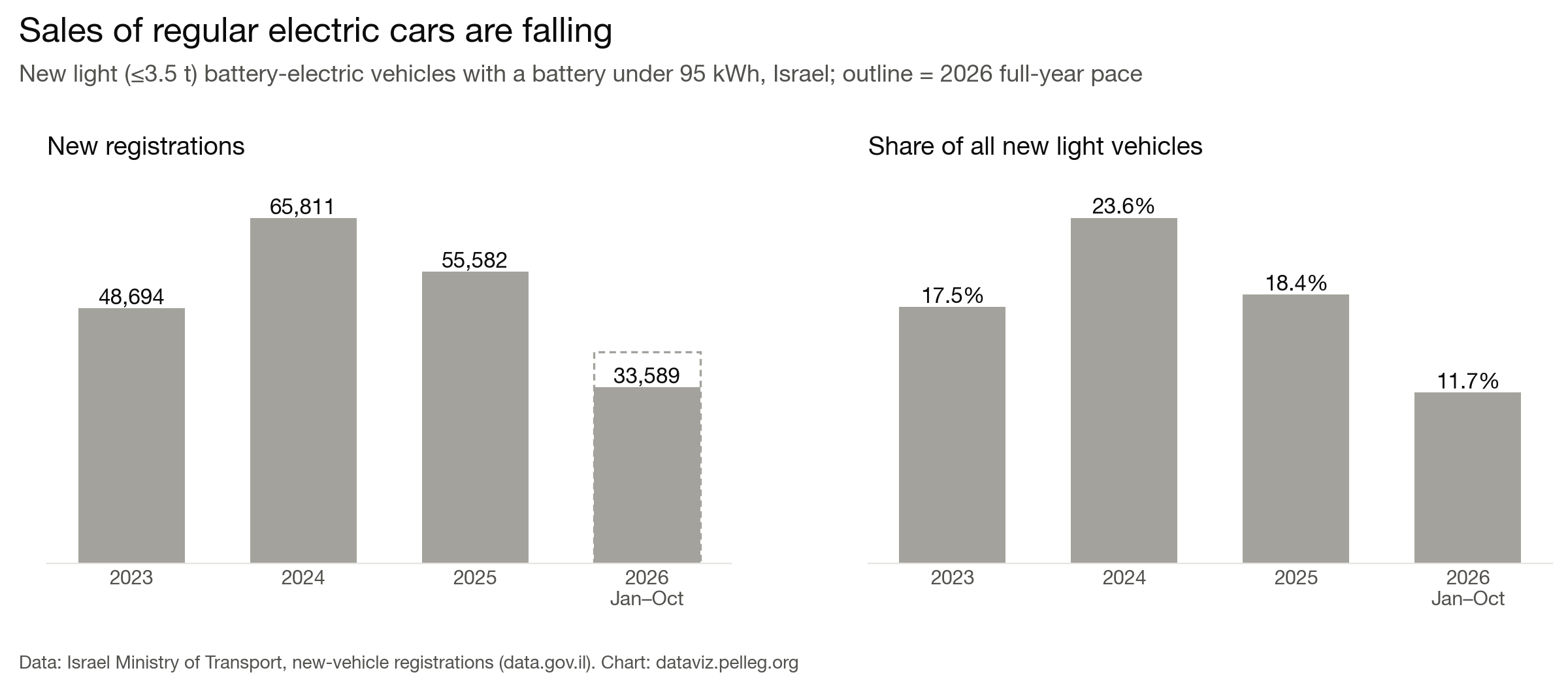
Regular EVs, with a battery under 95 kWh, are most of the electric cars on Israeli roads, typically 50–80 kWh. Their registrations peaked in 2024 at 65,800, which was 23.6% of all new light vehicles. They fell to 55,600 in 2025, and this year they are on pace for about 40,000, or 11.7% of the market.
Hybrids grew much faster over the same period. Hybrids and plug-in hybrids together went from 65,000 new registrations in 2023 to 165,000 in the first ten months of 2026. Plug-ins alone went from 6,800 in 2024 to 70,300 this year.
At the top of the range, the trend runs the other way:
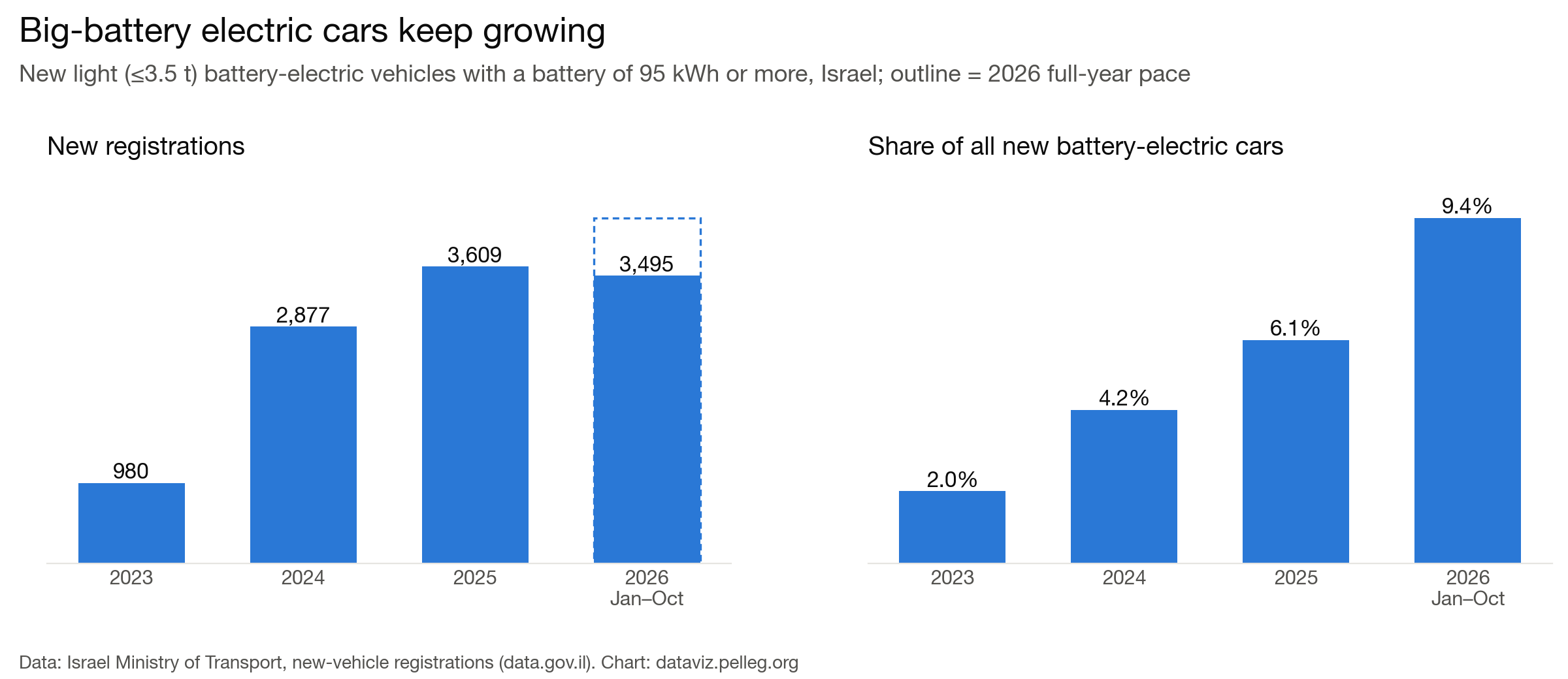
In 2023, fewer than 1,000 new electric cars had a battery of 95 kWh or more. There were 2,900 in 2024 and 3,600 in 2025, and this year is on pace for about 4,200. Their share of new fully electric cars went from 2.0% to 9.4%, so nearly one in ten now has a giant battery.
Chinese 100 kWh-class SUVs lead this segment: the Zeekr 7X and 001, the Xpeng G9 and the Voyah Free. American giants sit at the top end. The Cadillac Escalade IQ, with about 200 kWh, arrived in 2025 and has already sold more than 400 units.
2. Why? Some possible causes
Registration data shows what people bought, not why they bought it. Several things changed at the same time, and they probably all play a part:
- Taxes. The purchase tax on electric cars went from 35% in 2024 to 45% in 2025 and 48% in 2026. In 2025 the price ceiling for the reduced EV rate also dropped from NIS 50,000 to NIS 35,000. Company cars matter too: plug-in hybrids get a company-car tax benefit close to that of an EV, and many fleet drivers pick them for the benefit and rarely plug them in.
- More big-battery models to choose from. In 2023 there were few big-battery models on sale, and the BYD Tang and Voyah Free accounted for about 40% of them. Then the newcomers arrived. The Zeekr 001 and Xpeng G9 came in 2024 and together sold almost 1,600 that year. The Zeekr 7X and AVATR 11 followed in 2025. The 7X is the best-selling big-battery model of 2026, with 1,235 registrations so far. Buyers in this price range may also care less about a tax increase.
- The buyers with easy home charging may be running out. About 80% of Israelis live in apartment buildings, where installing a charger in shared parking is often a bureaucratic and technical headache. Early EV buyers were more likely to have a private house or their own parking spot. Once those buyers are served, the next ones depend on public charging, which is a harder sell.
3. The biggest batteries are in pickups, and most statistics miss them
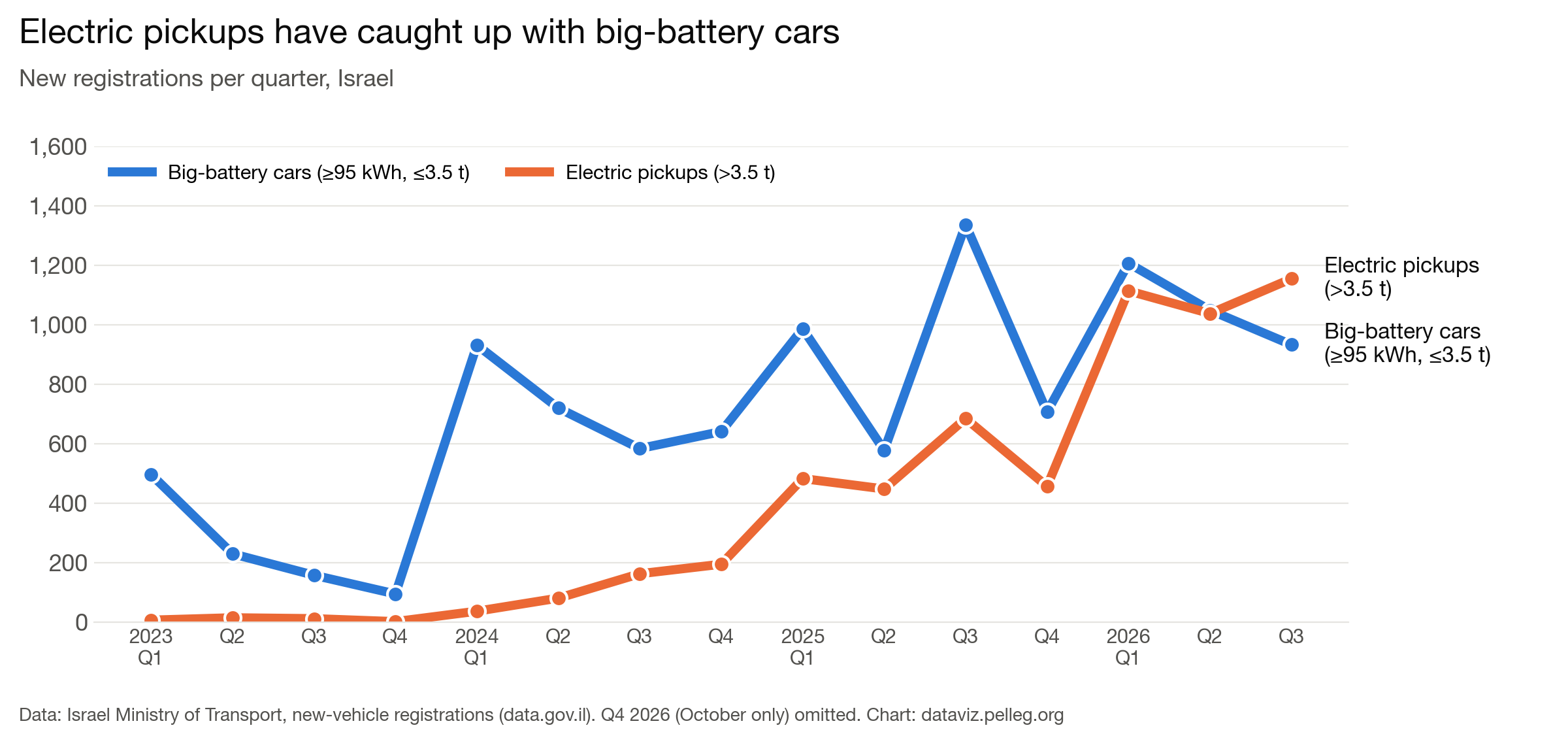
The fastest-growing group of big-battery vehicles hardly shows up in the usual EV statistics. Full-size American electric pickups, mainly the Chevrolet Silverado EV and the GMC Sierra EV, weigh more than 3.5 tonnes. Israel registers them as trucks, not private cars, so the standard "private EV" tables leave them out entirely.
Their numbers went from 36 in 2023 to 476 in 2024, 2,073 in 2025 and 3,613 in January–October 2026. That's more than all the big-battery passenger cars combined (3,495). Since 2023, 3,400 Silverado EVs and 2,100 Sierra EVs have been registered.
In this class, electric is no longer the niche option:
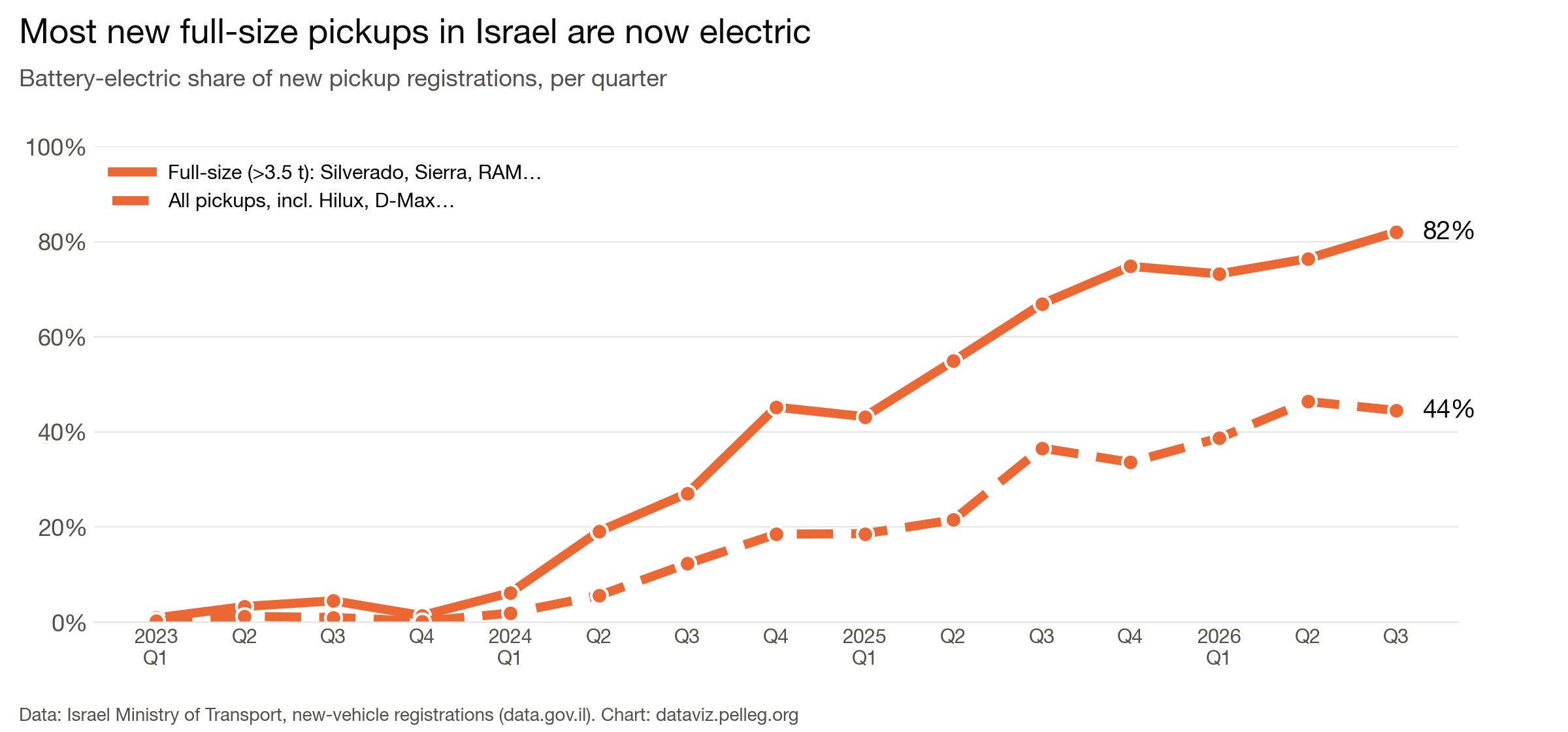
In early 2023, about 1 in 100 new full-size pickups was electric. In Q3 2026 it was 82%. If you add the smaller Hilux / D-Max class, which is still mostly diesel, about 43% of all new pickups sold in Israel this year are electric.
How big is "big"?
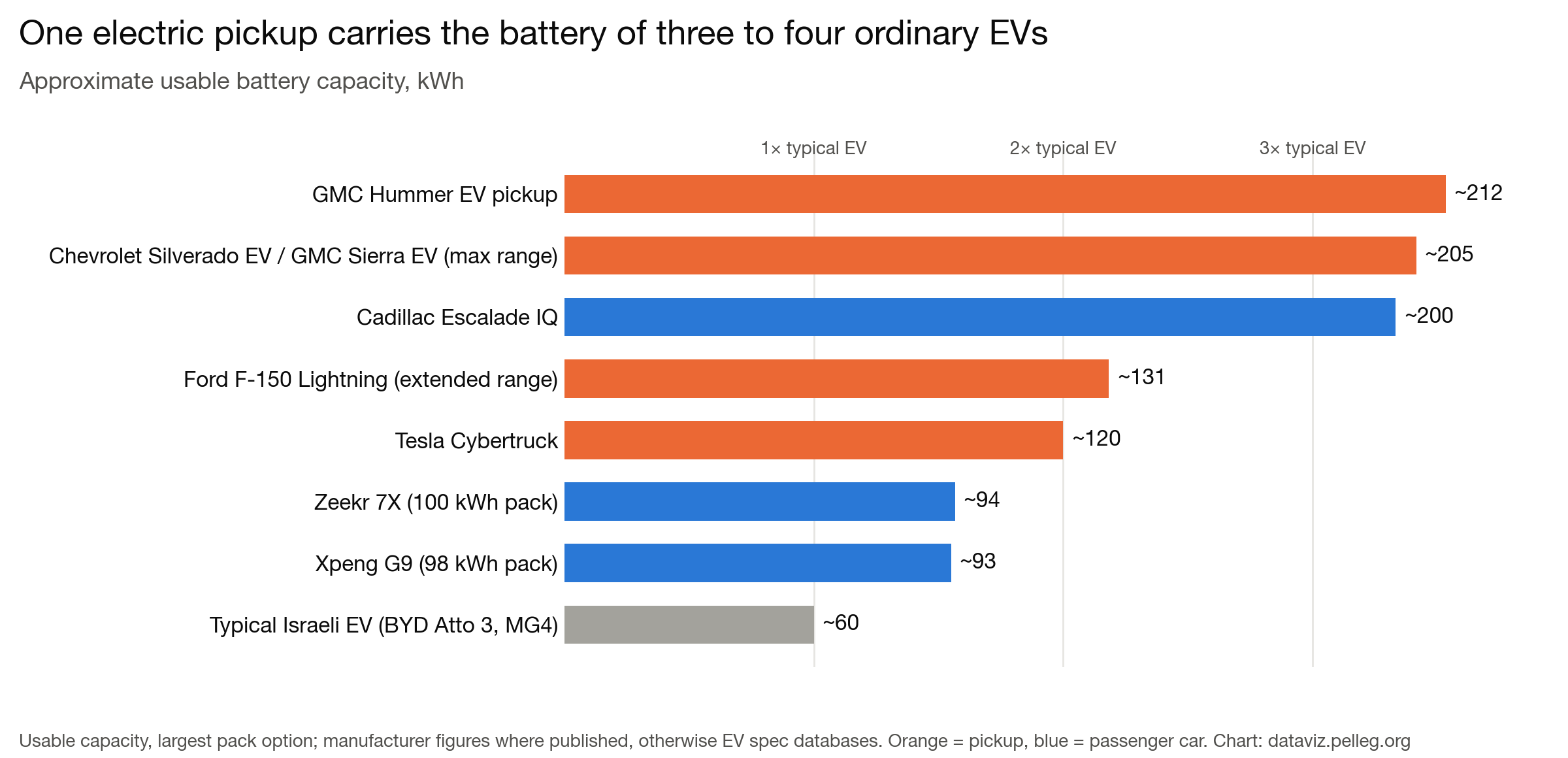
A Silverado EV or Hummer EV in its max-range version carries a usable battery of about 205–212 kWh. A typical Israeli EV like the BYD Atto 3 or MG4 has about 60 kWh. One pickup's pack holds as much energy as three or four of those cars.
A rough estimate puts this in perspective. Big-battery cars and electric pickups are about 17% of the new fully electric vehicles registered this year. Because their batteries are so large, they hold roughly a third of all the new battery capacity that went on Israeli roads in 2026.
Why it matters for charging
A 60 kWh car pulls into a fast charger, takes 25–30 kWh and leaves in about 25 minutes. A 205 kWh pickup charging from 10% to 80% needs about 145 kWh. Even on a 350 kW-capable 800V system, it will sit for about an hour at a 120–150 kW charger. Planning for charging stations, including how much power each site needs and how long each charger is occupied, should assume that more of the vehicles arriving are like this.
Method and caveats
- Data: Israel Ministry of Transport open data on data.gov.il. Vehicles up to 3.5 t come from the monthly new-vehicle deliveries, joined to the MoT WLTP catalogue to get the powertrain. Vehicles over 3.5 t come from the heavy-vehicle registry, by month of first registration. The heavy registry lists only active vehicles, which barely matters for vehicles this new.
- Battery size isn't recorded anywhere. I classified it by model name. "Big battery" means a nominal pack of 95 kWh or more. Several popular models (Zeekr 7X, Xpeng G9, NIO, Voyah Free) are also sold with a smaller pack, and I counted every unit of those models, so the passenger-car numbers are an upper bound.
- Pickups means battery-electric vehicles over 3.5 t from Chevrolet, GMC, Ford, Tesla and Rivian with a curb weight under 5 t. The pickup share charts use all pickups, diesel and petrol included, as the denominator.
- Battery capacities in the size chart are usable capacity for the largest pack option, rounded. GM says only "over 200 kWh" for the Escalade IQ and gives no exact figure for its trucks, and Tesla publishes none for the Cybertruck, so those come from EV spec databases and EPA filings. The 95 kWh threshold is nominal capacity; usable capacity is about 5% lower.
- The "a third of new battery capacity" estimate assumes 65 kWh for an average EV, 100 kWh for a big-battery car and 180 kWh for an average pickup.
- "2026" means January–October. The full-year pace is the Jan–Oct figure × 1.2.
- Tax figures are from Globes and Ynet. The apartment-living figure is also from Ynet.
- Not included: electric buses (about 750 a year and flat) and personal imports.
כתיבת תגובה